Where Parent early intervention makes Difference
At British Neurology Psychiatry Center, our pediatric neurology in Abu Dhabi services provide assessment, diagnosis and treatment for children and adolescents with neurological conditions.Our specialist team evaluates developmental and neurological concerns. We tailor each assessment to the child’s age, symptoms, medical history, and individual needs.
Our approach combines detailed neurological assessments with appropriate diagnostic evaluations. We also provide ongoing specialist follow-up to support each child’s development and wellbeing. In addition, we work closely with parents and families to ensure clear communication, coordinated care, and practical guidance throughout treatment.
Assessment of developmental delays and concerns about age-appropriate milestones, including speech, language, communication, social interaction, motor skills, learning, and developmental regression.
Assessment of speech, language, and communication delays in children, including concerns about delayed first words, limited vocabulary, difficulty understanding or expressing language, and social communication.
Assessment of children with concerns about autism, social communication, repetitive behaviours, sensory differences, and other neurodevelopmental concerns, with appropriate neurological evaluation when indicated.
Assessment of behavioural and developmental concerns in children, including frequent outbursts, emotional dysregulation, unusual behaviours, attention difficulties, and concerns affecting daily functioning and development.
Evaluation and management of seizures and epilepsy in children, including suspected seizures, recurrent episodes, staring spells, febrile seizures, and established epilepsy.
Evaluation of motor development concerns, low muscle tone, weakness, coordination difficulties, and suspected neuromuscular conditions in children.
Assessment of children with learning, cognitive, attention, and concentration difficulties, particularly when neurological or developmental factors may be contributing to challenges at school or in daily life.
Evaluation and management of headaches and migraine in children and adolescents, including recurrent headaches, migraine attacks, and other childhood headache disorders.
Assessment of children with tics, repetitive or involuntary movements, tremors, coordination difficulties, and other abnormal movement patterns.
Assessment of sleep concerns in children when neurological or developmental factors may be contributing, including disrupted sleep, unusual nighttime behaviours, and sleep-related neurological symptoms.
Evaluation and ongoing neurological care for children with cerebral palsy and other motor disorders, including muscle tone abnormalities, movement difficulties, coordination problems, and motor development concerns.
At British Neurology Psychiatry Center, our pediatric neurology services in Abu Dhabi provide comprehensive assessment, diagnosis, treatment, and ongoing care for children and adolescents with neurological and neurodevelopmental concerns.
Our specialist team provides child-focused neurological evaluation for concerns such as developmental delay, speech and communication difficulties, seizures, epilepsy, cerebral palsy, movement disorders, headaches, and other conditions affecting a child’s neurological development.
We work closely with parents and families to understand each child’s symptoms, developmental history, and individual needs, providing evidence-based care, appropriate diagnostic evaluation, and personalised management plans to support healthy development and long-term neurological wellbeing.

Specialized neurological assessment and care tailored to each child’s age, development, symptoms, and individual needs.
We work closely with parents and families to understand each child’s concerns, developmental history, and neurological needs.
Careful assessment supported by appropriate neurological evaluation to help understand symptoms and guide the next steps.
Personalized follow-up and coordinated care to support each child’s development, neurological health, and long-term wellbeing.

At British Neurology Psychiatry Center, pediatric neurological assessment begins with a detailed evaluation of each child’s symptoms, medical history, developmental progress, and neurological function.
Where appropriate, our specialists may recommend targeted diagnostic investigations and assessments to better understand neurological or developmental concerns and guide individualized care.
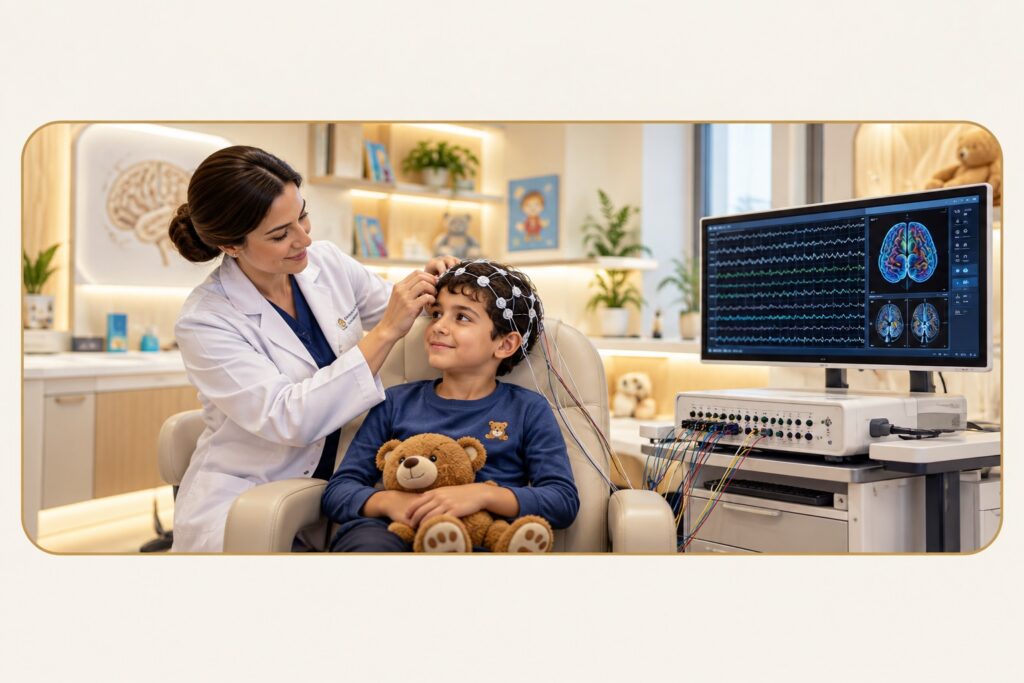
A non-invasive test that records the brain’s electrical activity and may help evaluate seizures, epilepsy, and other neurological conditions in children.
Diagnostic tests that assess the function of muscles and peripheral nerves and may help evaluate weakness, numbness, tingling, and suspected neuromuscular conditions in children.
Imaging studies used when clinically indicated to examine the brain, spinal cord, and other neurological structures and help identify or evaluate neurological conditions in children.
Comprehensive assessment of developmental, cognitive, communication, attention, and behavioural concerns to help understand a child’s individual needs and guide appropriate care and support.
Consider seeing a pediatric neurologist if your child has persistent, recurrent, unexplained, or concerning neurological or developmental symptoms. Early specialist assessment can help identify the underlying cause and determine whether further evaluation or treatment is appropriate.
Concerns about delayed speech, language, communication, motor skills, social development, or other developmental milestones that may require specialist assessment.
Frequent outbursts, unusual behaviours, emotional or developmental concerns, attention difficulties, or changes in behaviour that may benefit from specialist assessment.
Seizures, staring spells, unexplained episodes of loss of awareness, unusual movements, or other episodes that may require pediatric neurological assessment.
Sleep difficulties, frequent tantrums, emotional outbursts, unusual nighttime behaviours, or changes in behaviour that may be associated with developmental or neurological concerns.
Delayed motor development, frequent falls, muscle weakness, low muscle tone, coordination difficulties, or changes in the way a child walks or moves.
Involuntary movements, repetitive movements or sounds, tics, tremors, or other unusual movement patterns that may require pediatric neurological assessment.
Your child’s first pediatric neurology appointment is an opportunity to discuss their symptoms, medical and developmental history, and your concerns as a parent. Our pediatric neurologist will carry out a detailed clinical assessment and, when appropriate, recommend further investigations to better understand your child’s condition and develop an individualized care plan.
Review of your child’s symptoms, medical and developmental history, medications, previous evaluations, and relevant family health information.
A child-friendly neurological examination assessing movement, muscle tone, strength, coordination, reflexes, sensation, and other neurological functions appropriate to your child’s age and development.
A personalized care plan based on your child’s symptoms, developmental needs, neurological assessment, and diagnostic findings, with recommendations for treatment, follow-up, and ongoing support.
Your neurologist will discuss the findings and develop an individualized plan for treatment, follow-up, and ongoing care.
Consider seeing a pediatric neurologist if your child has persistent, recurrent, unexplained, or concerning neurological or developmental symptoms. This may include developmental or speech delay, seizures or unusual episodes, frequent headaches, abnormal movements, weakness, coordination difficulties, or other changes affecting development or daily functioning.
The assessment begins with a detailed discussion of your child’s symptoms, medical and developmental history, and your concerns as a parent. The neurologist then performs a child-friendly neurological examination, which may assess movement, muscle tone, strength, coordination, reflexes, sensation, walking, and other neurological functions appropriate to your child’s age and development.
Not every child needs additional tests. Depending on the symptoms and clinical findings, the neurologist may recommend investigations such as EEG, MRI or other imaging, blood tests, genetic testing, or EMG and nerve conduction studies when clinically appropriate.
A referral may be recommended depending on your child’s healthcare provider, insurance requirements, or the circumstances of the consultation. If you are concerned about your child’s neurological or developmental health, you can contact the center to discuss the appropriate pathway for an appointment.
Follow-up frequency depends on your child’s diagnosis, symptoms, treatment plan, developmental needs, and clinical progress. Your pediatric neurologist will recommend an appropriate follow-up schedule based on your child’s individual needs.